Last updated: 2026-08-16
615 Septic Tank Pumping is a licensed septic service provider in Nashville, TN. Buying a home on a septic system for the first time means inheriting a piece of buried infrastructure with no manual, no service history, and no obvious way to tell what condition it is in. The first service call fixes all three.
What happens on the first visit
A first call for new homeowner septic service in Nashville starts with the four stages below. Nothing is fitted, dug or replaced without being quoted first, and the price is confirmed before work begins.
-
Book inside 90 days of closing
Early enough that the baseline reflects the previous owner's usage, which is the thing worth knowing.
-
Locate and mark
Tank, access port and field footprint are found and marked, and the positions recorded so they are never lost again.
-
Pump and inspect
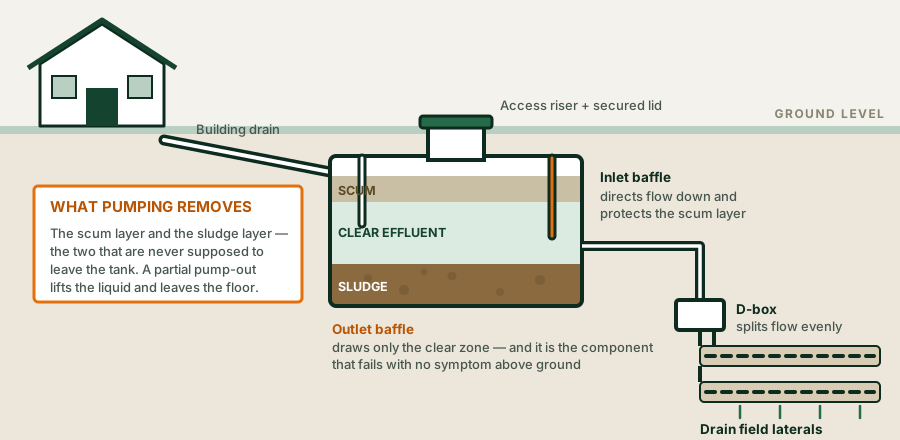
A full baseline pump-out with an empty-tank inspection — the clean slate every future reading is compared against.
-
Walkthrough and interval
Twenty minutes on how the system works, what damages it, and when the next service is due.
Why the first 90 days is the useful window
Pump-out readings taken shortly after closing measure the previous household's usage, not the new one. That is genuinely informative: a tank three-quarters full of sludge after a stated five-year interval says the system was overloaded or the pumping never happened.
Wait two years and those readings blend the old owner's habits with the new one's, and the baseline is gone. The reading is only clean while it is early.
The short list of things that actually damage a septic system
Wipes, including the ones labelled flushable — they do not break down and they form the mats that block inlets. Grease down the kitchen sink. Solvents, paint and heavy bleach loads that suppress the bacterial population. A water softener discharging its regeneration cycle into the tank. Driving or parking on the drain field. Downspouts and driveway runoff routed across it.
That list is short and every item on it is avoidable. Most first-time septic owners have never been told any of it, which is why the walkthrough is part of the visit rather than a leaflet.
Knowing what was permitted, not just what is there
Tennessee septic systems are permitted through the county environmental health office, and the file usually records tank capacity, field size, and the bedroom count the system was designed for.
That last figure matters for anyone planning to finish a basement or add a bedroom in Davidson County — expanding the house beyond the system's permitted capacity is a permit issue as well as a practical one, and it is much easier to find out now than during a future sale.
When this service is the right call
The signals below are the ones that bring most Nashville properties to this service. Any one of them is worth a call; several together usually mean the system is already past the point where waiting is cheap.
- A closing completed in the last 90 days
- No service records handed over at closing
- A first septic system after a lifetime on municipal sewer
- Uncertainty about where the tank and field even are
- A home inspection that mentioned the septic system only in passing
What is included
Every new homeowner septic service visit covers all eight of these. They are not tiers or add-ons — the list is what the job is.
- Tank located and marked, with the position recorded
- Full baseline pump-out
- Pre-pump readings taken to gauge how the previous owner used the system
- Empty-tank inspection of baffles, walls, floor and filter
- Drain field footprint identified and marked
- Walkthrough of what the system is, where it is, and what harms it
- Written baseline report and a calculated service interval
- County permit record pulled where one exists
Paying for it, and what the alternative costs
Quoted as a combined baseline pump-out and inspection; confirmed on the call.
For scale: a drain field replacement in Middle Tennessee is commonly quoted at $6,000 to $10,000, against published 2026 national figures of roughly $5,000 to $20,000. The whole economic case for maintaining a septic system is the gap between those two numbers. Pricing here is confirmed on site before work starts, and the cost estimator shows the full formula rather than asking for contact details first.
Doing it properly versus doing it cheaply
The invoice for a thorough job and a rushed one look similar. What separates them is whether the tank was emptied to the floor, whether anyone looked at the baffles while it was open, and whether the property owner ends up knowing anything they did not know before.
| What matters | Do nothing / DIY | Cheapest quote | Done properly |
|---|---|---|---|
| What leaves the tank | Not achievable — domestic septage removal requires a permitted hauler and a licensed disposal site. | Liquid drawn off; compacted sludge on the floor usually stays. | Liquid, scum and sludge removed to a visible tank floor. |
| Baffle inspection | None. Opening a tank is a confined-space hazard. | Rarely — the tank is often not emptied enough to see them. | Inlet and outlet checked with the tank empty, photographed. |
| Effluent filter | Usually unknown to the owner. | Commonly missed; a blocked filter mimics a full tank. | Located, rinsed, condition recorded. |
| What you know afterwards | Nothing new. | That it was pumped. No readings, no interval. | Sludge depth, component condition, and a dated next-service interval. |
| Effect on the drain field | Continues to degrade. | Working volume only partly restored — symptoms often return within months. | Full working volume restored; solids stop reaching the field. |
| Typical cost | $0 upfront, against a $6,000–$10,000 drain field replacement. | At or below the $275 low end, repeated more often. | $275–$525 on a 3–5 year interval. |
| Paper trail | None. | An invoice. | Dated findings for insurance, a sale, or the next inspection. |
Related resources
- Decision Guide
How Often Should a Nashville Tank Be Emptied?
Three to five years is the rule of thumb. Here is what actually decides where a specific Nashville system falls in that range — and how to replace the guess with a date.
Read the guide
- Decision Guide
How Do I Find Where My Septic Tank Is Buried?
Records first, ground second, shovel last. Done in that order most Davidson County tanks are found in under an hour with almost no disturbance.
Read the guide
- Rules & Permits
Do I Need a Permit for Septic Work in Davidson County?
Pumping does not need a permit. Almost everything else that opens the ground does — and Davidson County is one of the contract counties with an extra layer.
Read the guide
- Decision Guide
What Should Never Go Down a Septic System?
A short list, and every item on it is avoidable. Most first-time septic owners in Nashville have never been told any of it.
Read the guide
Frequently asked questions
What should a new septic owner do first?
Schedule a pump-out and inspection within 90 days of closing. It establishes how full the tank is, what condition the components are in, and whether there are existing problems — a clean baseline for everything after.
What if the previous owner says it was pumped recently?
The pre-pump readings will confirm or contradict it in about five minutes. It is a common claim and it is right roughly as often as it is wrong.
How do you find out where the tank and field are?
County permit records first, then an interior check and surface survey, then probing. The positions are marked and recorded so they never have to be found again.
How often will it need pumping from here?
Every three to five years under typical conditions — a household of four on a 1,000-gallon tank sits at the shorter end, a couple with a 1,500-gallon tank at the longer. The baseline readings turn that range into a specific date.
What area does 615 Septic Tank Pumping cover?
Nashville and Davidson County, including Bellevue, Antioch, Hermitage, Donelson, Madison, Green Hills, Goodlettsville, Old Hickory, Joelton and the surrounding Middle Tennessee area. Call to confirm coverage for a specific address.