Last updated: 2026-08-16
615 Septic Tank Pumping is a licensed septic system service provider in Nashville, TN. A drain field replacement in Middle Tennessee commonly runs $6,000 to $10,000, and nationally published 2026 figures span $5,000 to $20,000. That is enough money to be worth confirming the field has genuinely failed before it is dug up.
What happens on the first visit
A first call for drain field inspection in Nashville starts with the four stages below. Nothing is fitted, dug or replaced without being quoted first, and the price is confirmed before work begins.
-
Read the tank first
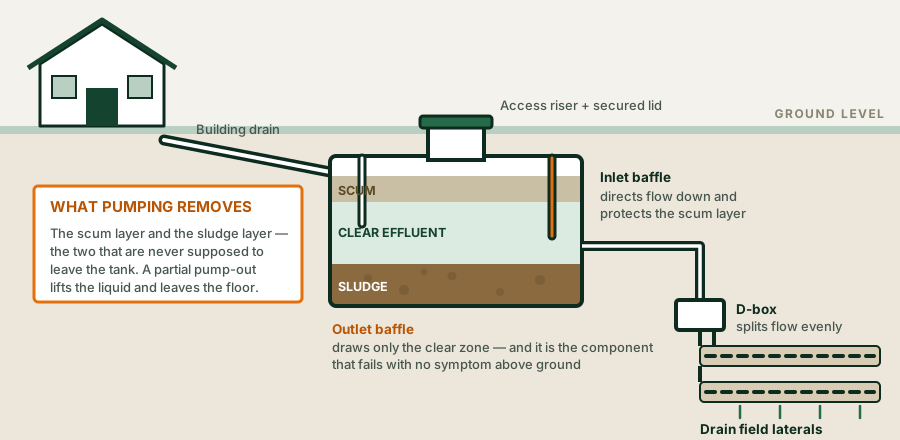
Liquid level relative to the outlet is the single strongest indicator of whether the field is accepting flow.
-
Open the distribution box
Where accessible, lateral levels show whether flow is being distributed evenly or one run is doing all the work.
-
Survey and probe the field
Surface condition and probe resistance across the footprint identify saturated or blinded areas.
-
Written finding
Sound, overloaded but recoverable, or failed — with the evidence behind the conclusion, not just the conclusion.
Failed, overloaded, and wet-weather-limited are three different findings
A failed field has lost its soil interface: the biomat has sealed the trench walls and effluent cannot leave regardless of conditions. That field needs replacing.
An overloaded field is structurally fine but receiving more water than it was sized for — often after an addition, a new household, a leaking fixture, or a water softener discharging into the system. Fixing the input can bring it back. A wet-weather-limited field copes for most of the year and saturates when the surrounding ground does; it may need diversion of surface water rather than replacement. Telling these apart is the entire point of the inspection.
Why Middle Tennessee fields fail the way they do
Davidson County soils are shallow and clay-heavy over fractured limestone. Clay accepts water slowly, so fields here are typically sized generously and are unusually sensitive to compaction and to surface water routed onto them.
Two local habits shorten field life more than anything else: driving or parking on the field footprint, which compacts the soil and crushes laterals, and downspouts or driveway runoff discharging across it. Both are fixable, and both are checked during the survey.
What cannot be assessed, and being clear about it
Some questions need excavation or a soil scientist to answer definitively — original trench depth, aggregate condition, and whether the installed field matches its permit. Where the answer requires that, the report says so rather than guessing.
Records held by the Davidson County environmental health office can often confirm the permitted design and installation date, and the report identifies when it is worth pulling them.
When this service is the right call
The signals below are the ones that bring most Nashville properties to this service. Any one of them is worth a call; several together usually mean the system is already past the point where waiting is cheap.
- Wet or spongy ground over the field in dry weather
- Effluent surfacing, or unusually dark green grass in strips
- Backups that appear only after sustained rain
- Tank liquid level standing above the outlet invert
- A quote for field replacement that the owner wants a second view on
What is included
Every drain field inspection visit covers all eight of these. They are not tiers or add-ons — the list is what the job is.
- Tank liquid level read against the outlet invert
- Evidence of solids carryover assessed at the outlet baffle
- Distribution box opened and lateral levels compared where accessible
- Surface survey of the field footprint for saturation and surfacing
- Probe testing at lateral positions
- Review of household flow against field capacity
- Rainfall-correlation assessment for wet-weather-only failures
- Written finding: sound, overloaded, or failed
Paying for it, and what the alternative costs
Quoted per site; the assessment is normally combined with a tank pump-out because the tank readings are part of the diagnosis.
For scale: a drain field replacement in Middle Tennessee is commonly quoted at $6,000 to $10,000, against published 2026 national figures of roughly $5,000 to $20,000. The whole economic case for maintaining a septic system is the gap between those two numbers. Pricing here is confirmed on site before work starts, and the cost estimator shows the full formula rather than asking for contact details first.
Doing it properly versus doing it cheaply
The invoice for a thorough job and a rushed one look similar. What separates them is whether the tank was emptied to the floor, whether anyone looked at the baffles while it was open, and whether the property owner ends up knowing anything they did not know before.
| What matters | Do nothing / DIY | Cheapest quote | Done properly |
|---|---|---|---|
| What leaves the tank | Not achievable — domestic septage removal requires a permitted hauler and a licensed disposal site. | Liquid drawn off; compacted sludge on the floor usually stays. | Liquid, scum and sludge removed to a visible tank floor. |
| Baffle inspection | None. Opening a tank is a confined-space hazard. | Rarely — the tank is often not emptied enough to see them. | Inlet and outlet checked with the tank empty, photographed. |
| Effluent filter | Usually unknown to the owner. | Commonly missed; a blocked filter mimics a full tank. | Located, rinsed, condition recorded. |
| What you know afterwards | Nothing new. | That it was pumped. No readings, no interval. | Sludge depth, component condition, and a dated next-service interval. |
| Effect on the drain field | Continues to degrade. | Working volume only partly restored — symptoms often return within months. | Full working volume restored; solids stop reaching the field. |
| Typical cost | $0 upfront, against a $6,000–$10,000 drain field replacement. | At or below the $275 low end, repeated more often. | $275–$525 on a 3–5 year interval. |
| Paper trail | None. | An invoice. | Dated findings for insurance, a sale, or the next inspection. |
Related resources
- Cost Guide
How Much Does Drain Field Replacement Cost in Nashville?
The five-figure number that routine pumping exists to prevent — what it covers, what moves it, and the cheaper findings worth ruling out first.
Read the guide
- Decision Guide
How Does Karst Ground Affect a Septic System in Middle Tennessee?
Fractured limestone under a thin soil mantle is the defining ground condition across Davidson County, and it changes both how a system fails and where a new one can go.
Read the guide
- Rules & Permits
Do I Need a Permit for Septic Work in Davidson County?
Pumping does not need a permit. Almost everything else that opens the ground does — and Davidson County is one of the contract counties with an extra layer.
Read the guide
Frequently asked questions
Can a failed drain field be restored instead of replaced?
Sometimes, when the finding is overload rather than failure — reducing input, diverting surface water, and resting the field can recover capacity. A field whose soil interface has fully sealed does not recover, and the report distinguishes the two.
How much does drain field replacement cost around Nashville?
Middle Tennessee replacements are commonly quoted at $6,000 to $10,000 depending on size, soil and access, against a national 2026 range of roughly $5,000 to $20,000. Confirming failure before committing to that is the point of the inspection.
Does replacement need a permit in Davidson County?
Yes. Repair or replacement of a subsurface sewage disposal system requires a construction permit from the county environmental health office under Tennessee's SSDS regulations, and a licensed installer must do the work.
Why does the system only back up when it rains?
Because the surrounding soil is saturated and the field temporarily has nowhere to discharge to. It usually means the field is at its limit rather than dead, and surface water management is worth investigating before replacement.
What area does 615 Septic Tank Pumping cover?
Nashville and Davidson County, including Bellevue, Antioch, Hermitage, Donelson, Madison, Green Hills, Goodlettsville, Old Hickory, Joelton and the surrounding Middle Tennessee area. Call to confirm coverage for a specific address.