Last updated: 2026-08-16
615 Septic Tank Pumping is a licensed septic service provider working across Nashville's limestone country. Karst is the defining ground condition in Middle Tennessee: soluble limestone bedrock, a thin and clay-heavy soil mantle above it, and solution features — sinkholes, swallets, fractured zones — that route water underground with very little filtration.
What happens on the first visit
A first call for septic service for karst and sinkhole-prone lots in Nashville starts with the four stages below. Nothing is fitted, dug or replaced without being quoted first, and the price is confirmed before work begins.
-
Read the ground first
Depressions, outcrops and drainage patterns are noted before the tank is opened, because they change what the findings mean.
-
Pump and inspect
Full pump-out with close attention to tank integrity — a leaking tank on karst is a groundwater problem, not just a maintenance one.
-
Assess the field's behaviour
A field that never shows saturation on clay soil may be short-circuiting through fractures rather than treating effluent.
-
Written findings
Condition, observed setbacks, and what a repair or replacement application would be up against on this ground.
Why a fast-draining field can be worse than a slow one
The intuitive reading of a drain field that never shows wet ground is that it is working well. On karst it can mean the opposite: effluent is reaching a fracture or solution channel and leaving the site quickly, without passing through the soil column that provides the actual treatment.
That is the pattern environmental health offices are trying to prevent when they enforce setbacks from solution features. It produces no symptom at the surface and no inconvenience to the household, which is exactly why it goes unnoticed.
Thin soil, generous setbacks, and a harder permit
Every new or replacement subsurface sewage disposal system in Tennessee requires a construction permit from the county environmental health office. On karst lots the review is stricter: soil depth to bedrock has to be adequate, and generous setbacks are enforced from any visible solution feature.
The counties across Middle Tennessee — Davidson, Williamson, Rutherford, Maury — apply this consistently, and soil maps from a soil scientist are commonly required. Knowing this before a field fails changes the planning horizon considerably, because the replacement option may not sit where the current field does.
Surface water is what opens sinkholes
Sinkhole formation is driven by concentrated water infiltration — downspouts discharging to one point, driveway runoff funnelled to a low corner, a leaking line. Limestone dissolves along those pathways and the soil above eventually collapses into the void.
On a septic lot the stakes are higher, because a new depression near the field can take the field with it. Reviewing where surface water goes is part of every visit on this ground, and it is usually the cheapest intervention available.
When this service is the right call
The signals below are the ones that bring most Nashville properties to this service. Any one of them is worth a call; several together usually mean the system is already past the point where waiting is cheap.
- A visible depression, sinkhole or swallet anywhere on the lot
- Shallow soil with limestone outcropping at the surface
- A drain field that drains suspiciously fast rather than slowly
- New settlement or a depression opening near the field
- A permit application held up over a solution feature setback
What is included
Every septic service for karst and sinkhole-prone lots visit covers all eight of these. They are not tiers or add-ons — the list is what the job is.
- Survey of the lot for visible solution features before work starts
- Full pump-out with tank integrity given specific attention
- Assessment of soil depth and outcrop around the field footprint
- Check for effluent short-circuiting rather than percolating
- Observed setbacks from any feature recorded in the report
- Surface water routing reviewed — the main sinkhole trigger
- Advice on what a permit application on this ground will face
- Written findings framed around groundwater, not just system function
Paying for it, and what the alternative costs
Standard pumping pricing applies; access constraints on steep or feature-affected lots are assessed on the call.
For scale: a drain field replacement in Middle Tennessee is commonly quoted at $6,000 to $10,000, against published 2026 national figures of roughly $5,000 to $20,000. The whole economic case for maintaining a septic system is the gap between those two numbers. Pricing here is confirmed on site before work starts, and the cost estimator shows the full formula rather than asking for contact details first.
Doing it properly versus doing it cheaply
The invoice for a thorough job and a rushed one look similar. What separates them is whether the tank was emptied to the floor, whether anyone looked at the baffles while it was open, and whether the property owner ends up knowing anything they did not know before.
| What matters | Do nothing / DIY | Cheapest quote | Done properly |
|---|---|---|---|
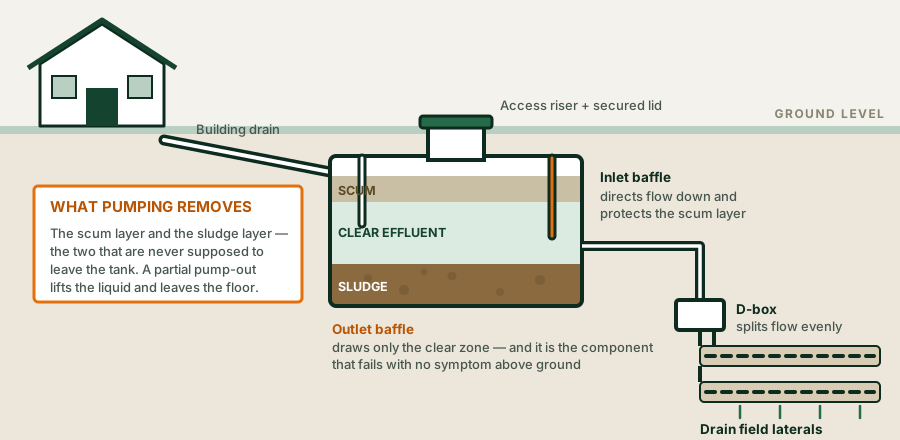
| What leaves the tank | Not achievable — domestic septage removal requires a permitted hauler and a licensed disposal site. | Liquid drawn off; compacted sludge on the floor usually stays. | Liquid, scum and sludge removed to a visible tank floor. |
| Baffle inspection | None. Opening a tank is a confined-space hazard. | Rarely — the tank is often not emptied enough to see them. | Inlet and outlet checked with the tank empty, photographed. |
| Effluent filter | Usually unknown to the owner. | Commonly missed; a blocked filter mimics a full tank. | Located, rinsed, condition recorded. |
| What you know afterwards | Nothing new. | That it was pumped. No readings, no interval. | Sludge depth, component condition, and a dated next-service interval. |
| Effect on the drain field | Continues to degrade. | Working volume only partly restored — symptoms often return within months. | Full working volume restored; solids stop reaching the field. |
| Typical cost | $0 upfront, against a $6,000–$10,000 drain field replacement. | At or below the $275 low end, repeated more often. | $275–$525 on a 3–5 year interval. |
| Paper trail | None. | An invoice. | Dated findings for insurance, a sale, or the next inspection. |
Related resources
- Decision Guide
How Does Karst Ground Affect a Septic System in Middle Tennessee?
Fractured limestone under a thin soil mantle is the defining ground condition across Davidson County, and it changes both how a system fails and where a new one can go.
Read the guide
- Rules & Permits
Do I Need a Permit for Septic Work in Davidson County?
Pumping does not need a permit. Almost everything else that opens the ground does — and Davidson County is one of the contract counties with an extra layer.
Read the guide
- Cost Guide
How Much Does Drain Field Replacement Cost in Nashville?
The five-figure number that routine pumping exists to prevent — what it covers, what moves it, and the cheaper findings worth ruling out first.
Read the guide
Frequently asked questions
Is a septic system safe on karst ground?
It can be, when it is correctly sited with adequate soil depth and proper setbacks from solution features — which is what the permit review is designed to ensure. The risk comes from systems sited before that scrutiny, and from tanks that have since developed leaks.
What happens if a sinkhole opens near the drain field?
It is reportable and it usually ends the field's usable life, because effluent can bypass the soil column entirely. It also triggers a setback constraint on where a replacement field can go, so it needs assessing rather than filling in.
Why do the counties enforce setbacks from sinkholes?
Because fractured limestone can carry water — and anything in it — long distances underground with very little filtration. Environmental health offices in Davidson, Williamson, Rutherford and Maury counties watch karst features closely for exactly this reason.
Does thin soil mean a septic system will not be permitted?
Not automatically, but conventional trench fields need adequate soil depth, and shallow sites often need an alternative system design signed off by an engineer. That is worth establishing before a replacement becomes urgent.
What area does 615 Septic Tank Pumping cover?
Nashville and Davidson County, including Bellevue, Antioch, Hermitage, Donelson, Madison, Green Hills, Goodlettsville, Old Hickory, Joelton and the surrounding Middle Tennessee area. Call to confirm coverage for a specific address.