Last updated: 2026-08-16
615 Septic Tank Pumping is a licensed septic inspection provider in Nashville, TN. Buyers and their agents increasingly ask for septic condition before closing, and an overdue or failing system discovered during the buyer's due diligence is negotiated against the seller under time pressure. Inspecting before listing moves that conversation onto the seller's schedule.
What happens on the first visit
A first call for pre-sale septic inspection in Nashville starts with the four stages below. Nothing is fitted, dug or replaced without being quoted first, and the price is confirmed before work begins.
-
Book before the listing goes live
Ideally four to eight weeks out, leaving room to address anything found without holding up the launch.
-
Pump and inspect
One visit: the tank is emptied and the full empty-tank inspection is carried out.
-
Report issued
Dated, photographed, and written so an agent or buyer can read it without interpretation.
-
Remedy or disclose
Anything found is either fixed before listing or documented for disclosure, on the seller's timeline rather than under contract.
The asymmetry of finding it first
A defect found by the seller's inspector is a repair with a quote attached. The same defect found by the buyer's inspector, three days before closing, is a negotiation in which the seller has no time and no alternative buyer.
The costs are not comparable. Sellers routinely concede several times the actual repair cost when a septic issue surfaces late, because the alternative is the deal collapsing and the listing going back to market carrying a known problem.
What buyers' agents actually ask for in Davidson County
The common requests are a recent pump-out receipt, a written condition report on the tank and its components, and confirmation that the system's permit record matches what is on the ground.
The permit file at the county environmental health office is worth pulling at the same time. It shows the permitted design — tank capacity, field size, bedroom count the system was approved for — and a mismatch between that and a house that has since gained bedrooms is exactly the kind of thing that stalls a closing.
Timing it so the report still counts
Most agents and lenders want an inspection carried out within six months of closing, so a report taken far in advance may need refreshing. Four to eight weeks before listing is the practical window: recent enough to satisfy the transaction, early enough to fix anything found.
The report is written to be handed straight to an agent or a buyer. Photographs of the empty tank, dated findings, and plain statements of condition — not a technician's shorthand that needs translating.
When this service is the right call
The signals below are the ones that bring most Nashville properties to this service. Any one of them is worth a call; several together usually mean the system is already past the point where waiting is cheap.
- A listing going live in the next few months
- No documented service history for the system
- An offer already accepted with a septic contingency
- A previous sale that fell through over system condition
- An agent asking for records the seller does not have
What is included
Every pre-sale septic inspection visit covers all eight of these. They are not tiers or add-ons — the list is what the job is.
- Full pump-out so the tank interior is genuinely visible
- Pre-pump liquid, scum and sludge readings recorded
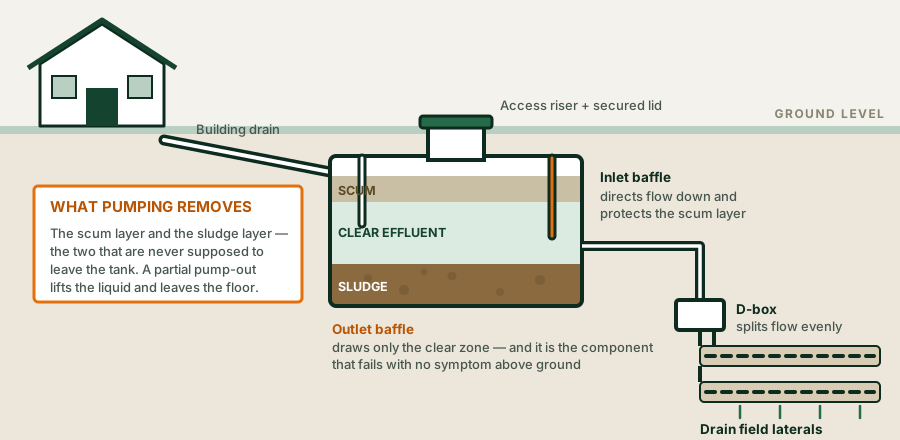
- Inlet and outlet baffle condition assessed and photographed
- Effluent filter condition and service
- Tank wall, floor, lid and riser condition
- Surface assessment of the drain field footprint
- Dated written report with photographs for the listing file
- Clear statement of anything that will need addressing, with rough cost
Paying for it, and what the alternative costs
Quoted as a combined pump-out and documented inspection; confirmed on the call.
For scale: a drain field replacement in Middle Tennessee is commonly quoted at $6,000 to $10,000, against published 2026 national figures of roughly $5,000 to $20,000. The whole economic case for maintaining a septic system is the gap between those two numbers. Pricing here is confirmed on site before work starts, and the cost estimator shows the full formula rather than asking for contact details first.
Doing it properly versus doing it cheaply
The invoice for a thorough job and a rushed one look similar. What separates them is whether the tank was emptied to the floor, whether anyone looked at the baffles while it was open, and whether the property owner ends up knowing anything they did not know before.
| What matters | Do nothing / DIY | Cheapest quote | Done properly |
|---|---|---|---|
| What leaves the tank | Not achievable — domestic septage removal requires a permitted hauler and a licensed disposal site. | Liquid drawn off; compacted sludge on the floor usually stays. | Liquid, scum and sludge removed to a visible tank floor. |
| Baffle inspection | None. Opening a tank is a confined-space hazard. | Rarely — the tank is often not emptied enough to see them. | Inlet and outlet checked with the tank empty, photographed. |
| Effluent filter | Usually unknown to the owner. | Commonly missed; a blocked filter mimics a full tank. | Located, rinsed, condition recorded. |
| What you know afterwards | Nothing new. | That it was pumped. No readings, no interval. | Sludge depth, component condition, and a dated next-service interval. |
| Effect on the drain field | Continues to degrade. | Working volume only partly restored — symptoms often return within months. | Full working volume restored; solids stop reaching the field. |
| Typical cost | $0 upfront, against a $6,000–$10,000 drain field replacement. | At or below the $275 low end, repeated more often. | $275–$525 on a 3–5 year interval. |
| Paper trail | None. | An invoice. | Dated findings for insurance, a sale, or the next inspection. |
Related resources
- Rules & Permits
Is a Septic Inspection Required to Sell a House in Tennessee?
There is no blanket state requirement. There is, in practice, a buyer's agent who will ask — and the timing of when you find out is worth real money.
Read the guide
- Cost Guide
How Much Does a Septic Tank Inspection Cost in Nashville?
Inspection is priced against pumping for one reason: almost nothing worth finding is visible until the tank is empty.
Read the guide
- Rules & Permits
Do I Need a Permit for Septic Work in Davidson County?
Pumping does not need a permit. Almost everything else that opens the ground does — and Davidson County is one of the contract counties with an extra layer.
Read the guide
Frequently asked questions
Is a septic inspection legally required to sell a home in Tennessee?
There is no blanket state requirement for a septic inspection at sale. In practice buyers, agents and lenders request one often enough that it functions as a condition of most transactions involving a septic system, and Tennessee's residential property disclosure obligations still apply to what the seller knows.
How far ahead of listing should it be done?
Four to eight weeks. Recent enough for the report to still be current at closing, early enough that anything found can be fixed without holding up the listing.
What if the inspection finds a problem?
Better then than during the buyer's due diligence. The report includes a rough cost for anything found, so the seller can choose between repairing before listing and disclosing with a price adjustment already thought through.
Does the buyer usually accept the seller's report?
Frequently yes, when it is recent, dated, photographed and independent of the sale. Some buyers still commission their own; a clean prior report makes that a formality rather than a discovery.
What area does 615 Septic Tank Pumping cover?
Nashville and Davidson County, including Bellevue, Antioch, Hermitage, Donelson, Madison, Green Hills, Goodlettsville, Old Hickory, Joelton and the surrounding Middle Tennessee area. Call to confirm coverage for a specific address.